
Why "direct" traffic is hiding your best channels
Here's what direct really is, what it costs you, and how to recover the signal.
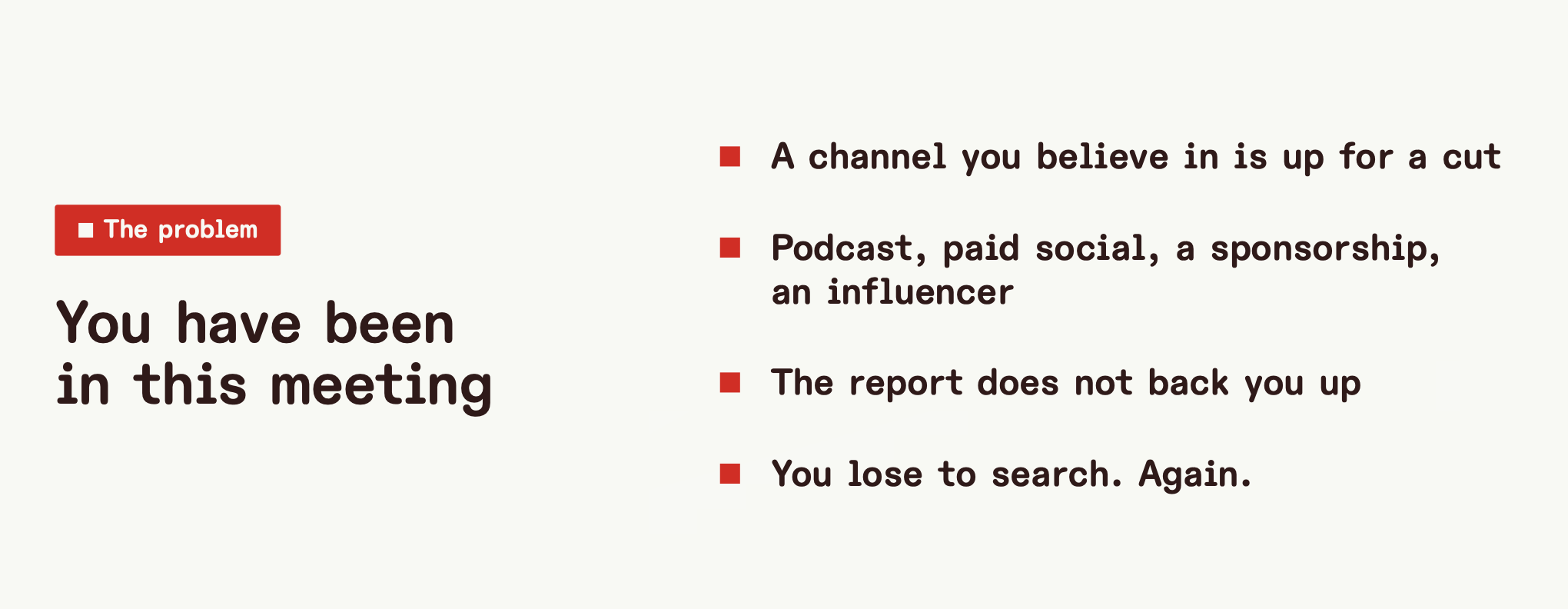
You are in a budget meeting. A channel you believe in is up for a cut: a podcast sponsorship, paid social, an influencer deal. You know it’s working. But the report doesn’t back you up, and you lose the argument to search. Yes, again.
The reason isn’t that your channel is weak.
It’s that its conversions are sitting in a bucket labelled direct, and nobody in the room knows how to read that bucket.
Direct doesn’t mean someone typed your URL
I feel like we shouldn’t have to say this, but:
There is no world (unfortunately) where a prospect dreams about your company, wakes up, types your domain into a browser, and converts.
A direct session almost always means they heard about you somewhere else, and your tracking couldn’t stitch that conversion back to the source.
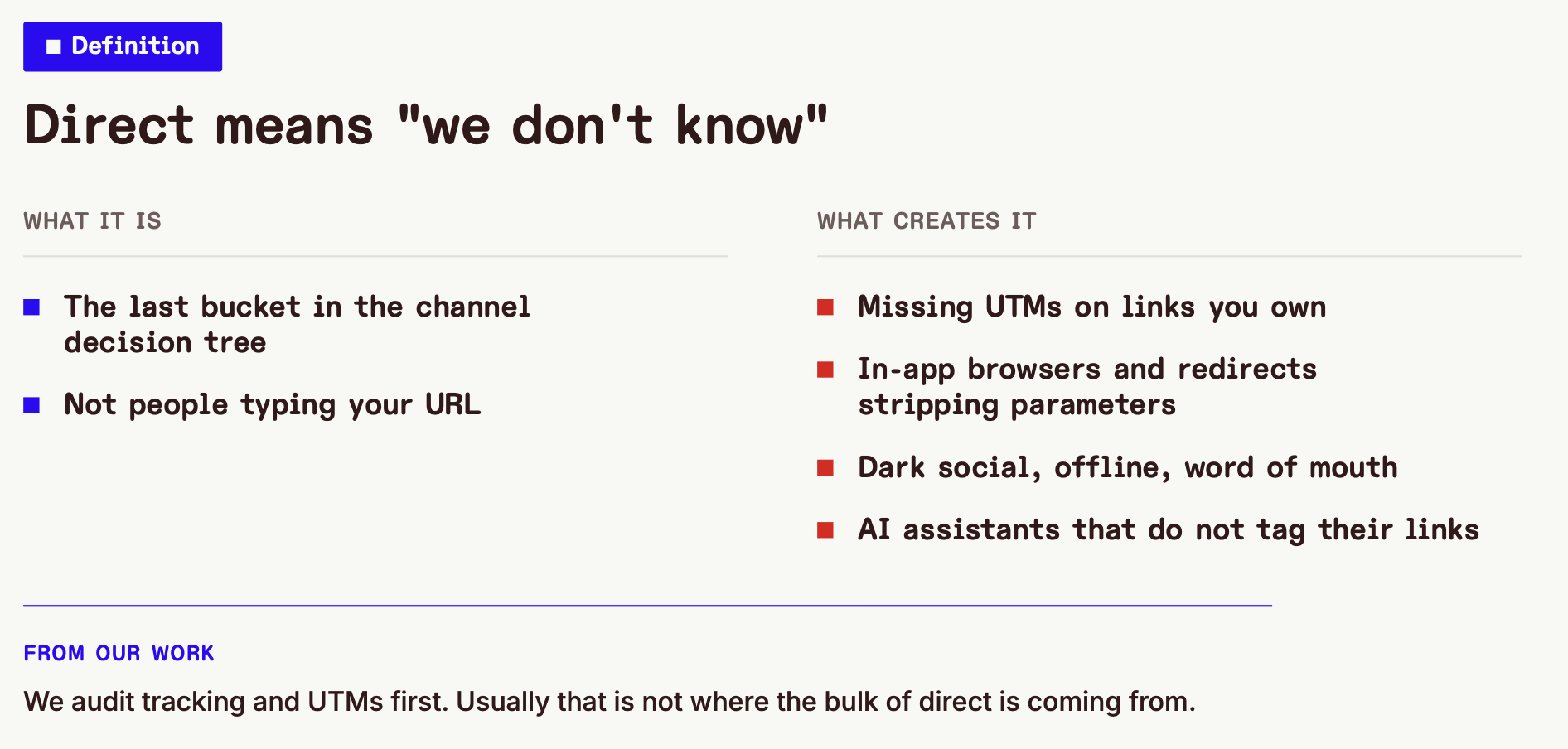
Direct is the last bucket in the channel decision tree. It’s where a conversion lands when nothing else matches. In practice it means: we don’t know.
A few things push conversions into it:
-
Missing UTMs on links you own, especially bottom funnel.
-
In-app browsers and redirects stripping parameters. Someone taps your Instagram ad, the page opens in the in-app browser, then they reopen it in Safari to finish. That’s a new user to your analytics, and the click trail is broken.
-
Dark social, offline, and word of mouth, which leave no link to read at all.
-
AI assistants that don’t tag their links. Some add a parameter, some don’t, and even when there’s a click you can’t see the impression that built the trust.
The mistake that costs you the budget
Here’s the reasoning I hear constantly, usually on LinkedIn: “You’ll never have perfect data, so make decisions with the data you have.”
It sounds sensible, which is why this argument is so dangerous.
Say your tool attributes 26% of conversions and files the other 74% as direct. (That’s not GA4 being sloppy, by the way. That’s a real number we saw from a client paying six figures a year for a well-known enterprise attribution tool.) The tempting read is: 26% is my sample, it’s annoying but workable, I’ll decide on that.
But the 74% is not a random sample of the same channels. It’s disproportionately the channels that don’t survive click-based tracking. So you can’t take the 26% and scale it up. The channels missing from your report are missing _because _they’re hard to measure, not because they’re small.
Which means measurability wins the argument by default. Search looks like the hero not because it creates the most demand, but because it’s the easiest to track, and it happily takes credit for demand created elsewhere. Every dollar that moves to search on that basis is a dollar moving on a measurement artefact, not on performance.
The 26% isn’t your sample. It’s just your trackable channels. The rest of your mix is in the other bucket, uncounted.
The channels most at risk are the ones that feel measurable
Not every hard-to-track channel is in danger. It depends on what the room expects to see.
Nobody expects out-of-home, TV, print, or a conference booth to show up in GA4. Ok, you might be forced to add QR codes to them but people know they won’t capture the full picture. Those get judged on other evidence from the start, so they’re rarely cut on analytics alone. (Luckily.)
The dangerous middle is the channel that feels trackable but isn’t. Podcast sponsorships, much of paid social, influencer and newsletter placements, dark social. You can add a UTM, so leadership expects to see results, and when the dashboard shows almost nothing, the channel looks weak. It gets cut or under-funded not because it failed necessarily, but often because it was mismeasured.
What recovery actually looks like
You don’t fix this by chasing better tracking only. We audit UTMs and tracking first on every project, and usually that’s not where the bulk of direct is coming from. We have to be very honest when a lead comes thinking an audit will uncover a silver bullet for this.
A high direct share is a channel-mix problem, not a tagging problem. No naming convention closes a gap created by journeys that never touched your site in a readable way.
What does work is recovering the signal from several angles and combining them:
-
Control the links you own. Automate your UTMs instead of tagging by hand in a spreadsheet. This proves nothing on its own, but everything else depends on it holding up.
-
Ask your customers. A “how did you hear about us” on the lead form or post-purchase names channels that leave no click trail. One client took direct from 50% to 20% on this alone. Placement matters more than the wording.
-
Give each placement its own destination. Vanity URLs, dedicated landing pages, and promo codes make a podcast or radio spot countable by design. For one client, that was the only signal those channels had.
-
Stitch identities. Detecting the in-app browser and joining sessions across it recovers the Meta and Instagram conversions that Safari hand-off was hiding.
-
Use incrementality. For linear TV, we’ve run a geo lift off location data rather than a holdout test. It answers the one question a finance team actually cares about: would these conversions have happened anyway?
Two honest caveats. None of this reclassifies all of direct, and anything that claims to is a black box you shouldn’t trust. A useful rule of thumb: if direct plus referral sits above 10% of conversions, there’s recovery work worth doing. We don’t look at a specific % for attributing traffic/sessions.
What “done” looks like in your numbers
We did this with Zeffy. Direct and referral fell from 51% to 8% of attributed conversions. Survey response coverage went from 80% to 90%. Stitching recovered around 2% of traffic as mobile social that had been invisible before.
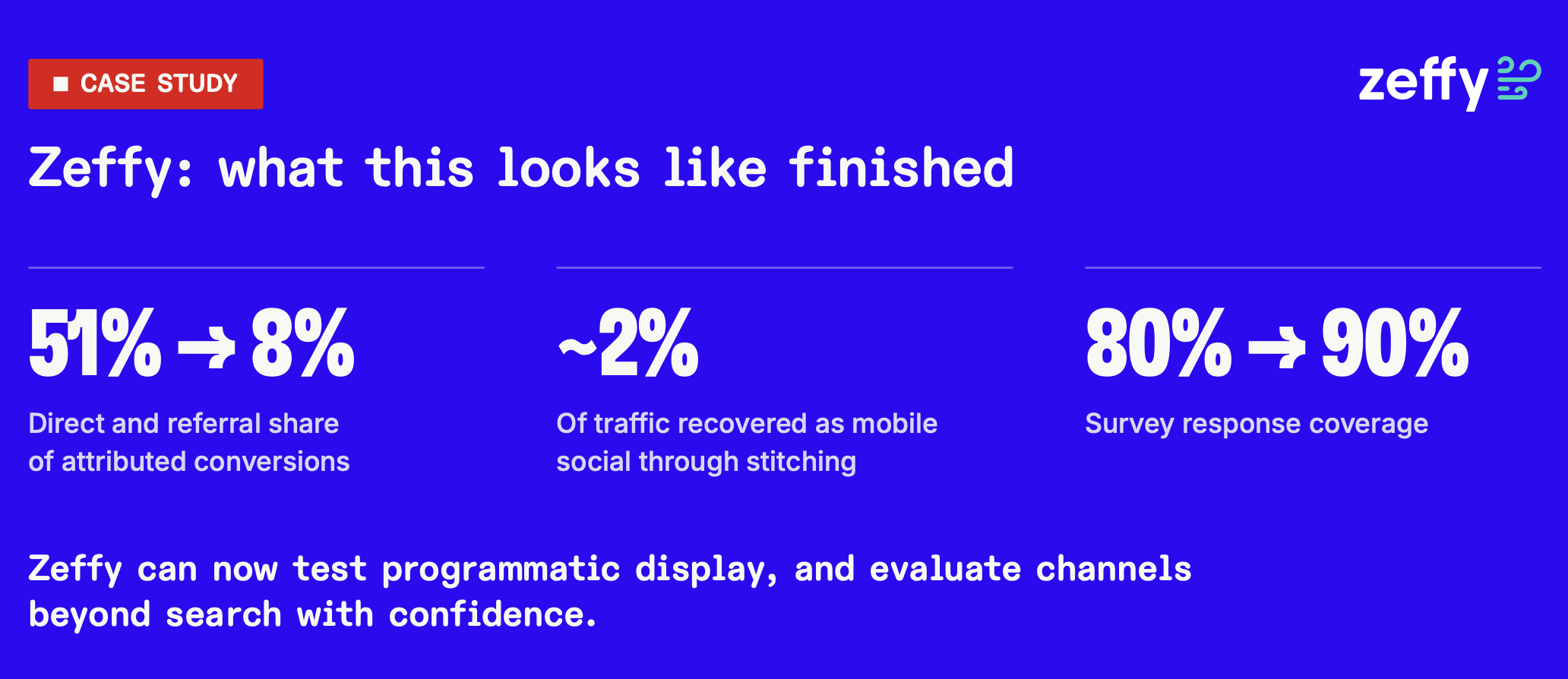
The point isn’t (just) the percentages. It’s what they let Zeffy do: test programmatic display, and evaluate channels beyond search, with enough confidence to put budget behind the answer.
You walk back into the budget conversation able to defend a channel with evidence instead of conviction, argue for more where the recovery is real, and accept a cut where it genuinely isn’t. You stop losing the argument to whatever happens to be easiest to track.
If your direct share is high and you suspect it’s burying channels you can’t currently defend, book a call with us and we’ll talk through what recovery would take for your setup.
More articles like this?
Enter your email below to receive our latest articles on marketing measurement:


 Future articles